Talk to the hand (don’t)
Before you read any further, say these out loud. Three times each, as fast as you can.
Red lorry, yellow lorry.
Unique New York.
Irish wristwatch.
If you're on a train, mouth them. I'll wait.
That's one vocal warm-up in the middle of my workshop. A room full of clinicians tripping over their own tongues and laughing at themselves. Nobody ever needs persuading to join in.
Then I'd say, "But my favourite vocal warm-up is this one," and reach behind the lectern for a bag that has exactly one job.
Out comes the puppet. It's me. Same spiky hair, same dark-rimmed glasses, black scrubs with my name stitched on the chest. Considerably more eyebrow. No beard.
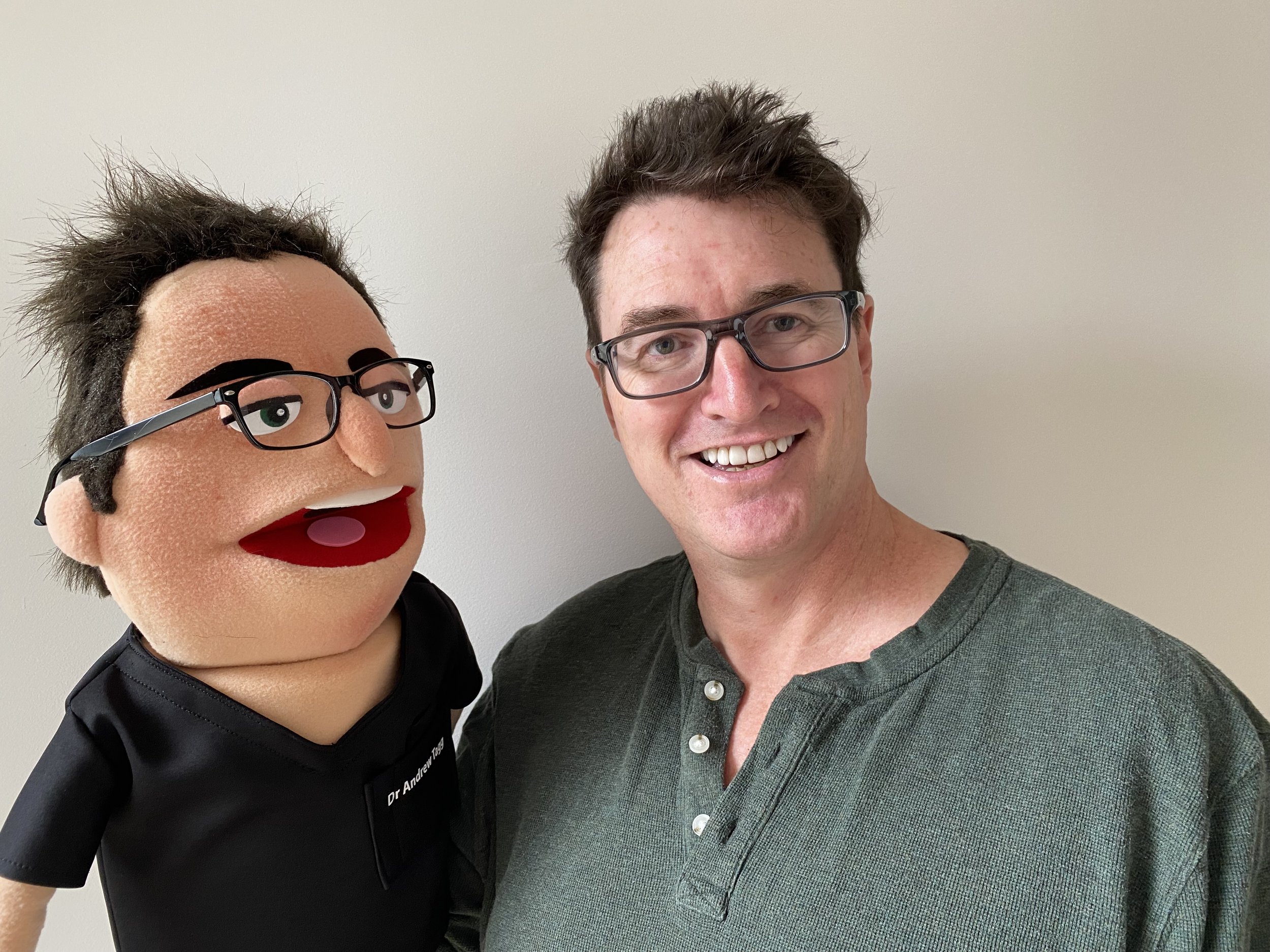
Spot the difference
The room laughs before I've done anything. Then I start singing Mahna Mahna and wait for them to sing it back.
A few do. Most have never heard the song. Everyone laughs anyway.
If you're in the never-heard-it camp, this is what you missed.
💡 ONE IDEA WELL
For a while the puppet stayed in its bag. I didn't trust myself to pull it off.
When I finally brought it out, I felt exposed every time. A grown man in front of a room of colleagues, singing nonsense syllables to a felt copy of his own face. But they laughed. At Frankston, then at Monash. So I told myself a story: awkwardness was the price of doing something brave, and the laugh was the proof it worked.
Then the Frankston feedback came back. Most of it was generous. One comment wasn't unkind. It just said what nobody in the room had said out loud. They loved the workshop. They didn't understand the point of the muppet.
I kept bringing it anyway.
At a hospital retreat I asked for more. Not just the laugh this time. I wanted the room to sing. I sang the call, and the answer came back thin.
So I walked the puppet across the room to someone I knew couldn't resist singing back.
They sang. Everyone else watched.
🧰 LESS MESS, MORE MESSAGE
A laugh tells you the room is with you. It doesn't tell you why.
When a room does the tongue twisters, they laugh with each other. Everyone's tripping over the same words, and the laugh is the sound of being in it together. When the puppet comes out, they laugh at it, and some of them laugh for me. A room of clinicians watching a colleague pull a puppet version of himself out of a bag knows what that costs. That's generosity, not evidence.
Laughing with is joining in. Laughing at and laughing for are watching. From the front, all three sound the same.
The warm-up was meant to get everyone joining in. The puppet turned them back into an audience. They still laughed, so I didn't notice the difference.
Every speaker has a puppet. The clip that took a weekend to edit. The opening joke that killed once in 2019. The slide you're proudest of. We keep them because we love them, then take the room's politeness as a verdict.
The tell isn't that it's hard. It's what you do when they hesitate. Every good moment of participation starts with a reluctant room. When you catch yourself walking across the room to the one person you know will play along, the moment has stopped being for them.
⌨️ TRY THIS
In the end, I didn't retire the puppet. An airline did. I was flying interstate for a workshop with carry-on only, and he wouldn't fit. He would have needed his own seat. So he stayed home in the bag with one job, and I ran the warm-up with just the three tongue twisters.
The room had no idea what they were missing. Neither, it turned out, did I. The section ran cleaner, and I wasn't bracing for the bit that came next.
So find your puppet. The clip, the joke, the slide. Then leave it at home once. Rehearse without it, or run the next talk without it, and pay attention to whether anything breaks. If you don't miss it, the room won't either.
If you can't bring yourself to cut it yet, ask it three questions. Could someone tell you afterwards what it was for? Is the room joining in, or watching? And when the room hesitates, do you wait for them, or go looking for a sure thing?
🧭 ASK YOURSELF THIS
What could you leave at home?