Spoiler Warning!
Someone who knows I care more about slide design than is strictly healthy for a grown man asked me recently, do you actually have to attribute every image you use?
I thought about the last workshop I'd sat in on.
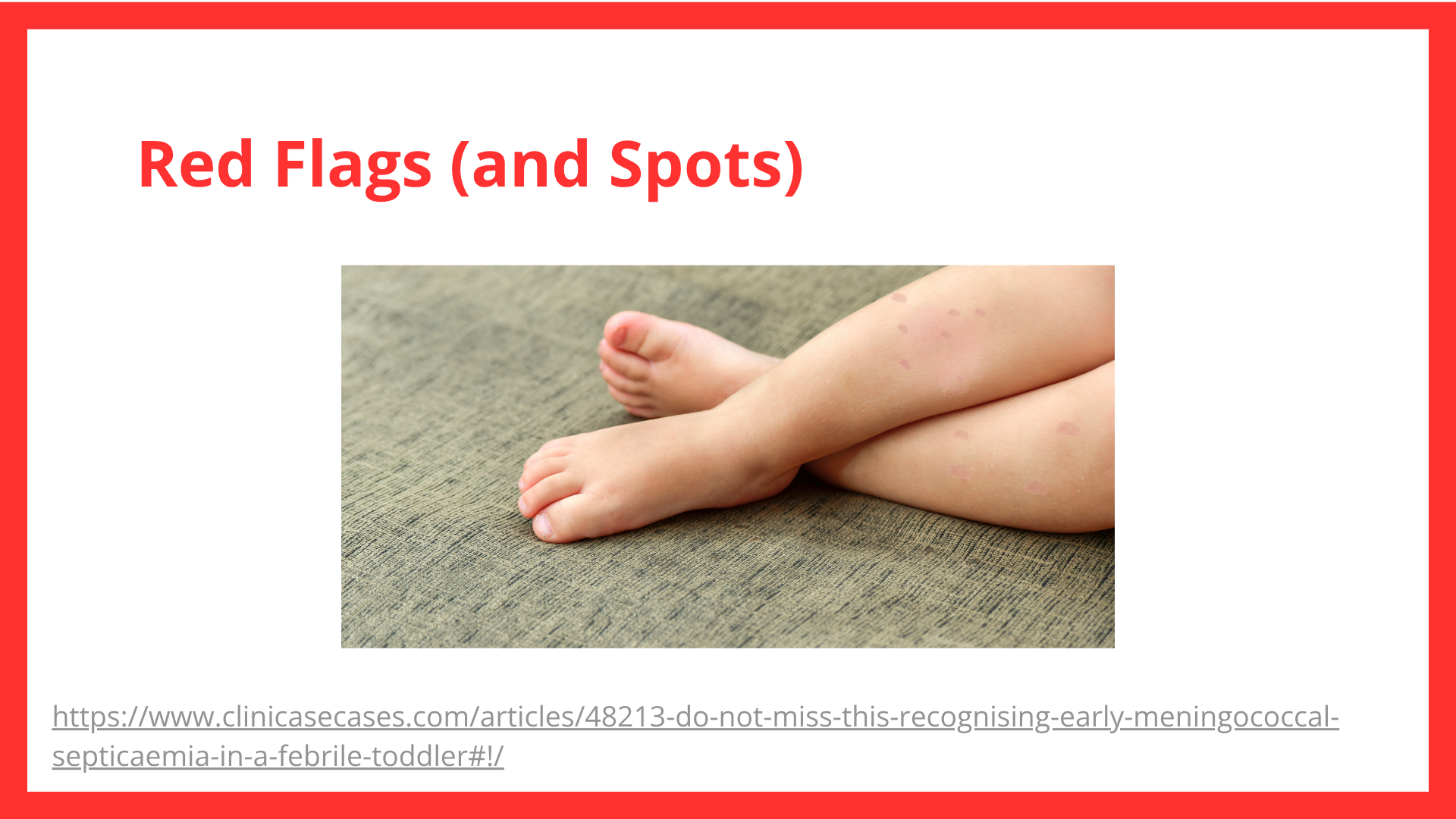
I'm in the third row of a paediatric workshop. The slide behind the speaker is titled Red Flags (and Spots): a girl on her mother's lap, snotty-nosed, a little flat, a scatter of small reddish marks across her shins that could be nothing. "She's off her food, temp's up a bit, mum noticed the spots this morning," the speaker says. "Would you send her home?"
Nobody wants to put their hand up and give the wrong answer.
Underneath the photo, in a font small enough you might need to look over your multifocals to read it, runs the citation: a URL ending in words nobody in the room has said yet, recognising early meningococcal septicaemia in a febrile toddler.
We hadn't even started discussing it. The slide had already told us the answer.
💡 ONE IDEA WELL
During the case, one delegate, braver than the rest of us, calls out: "Early meningococcaemia?" She's laughing before she's even finished the sentence, because she's spotted what the rest of us hadn't. The URL running along the bottom of the slide has already given the answer away.
The room laughs. The speaker laughs too, a little sheepishly, and for a second it looks like the whole thing might just become a shared joke and move on.
Then I put my hand up, not looking for a fight, just an easy fix: you don't really need the whole URL up there, you know, you could put it on a references slide at the end.
He stops laughing. "No, you have to. It's a legal requirement."
Not I think.
Not I was told.
Just stated, flat, closed, the way people talk when a sentence has been said enough times to start feeling true.
I said I didn't think that was actually right, that copyright asks for attribution, not for the citation to be the loudest thing on the slide. He didn't consider it either. He just repeated the fear as fact, louder this time, in front of everyone: you have to do it this way, or else.
Neither of us got sued that year. But something in the exchange stuck with me longer than the slide did.
It wasn't that he was wrong. People are wrong about small things constantly, myself included, more often than I'd like to admit. The room had already laughed about the URL, he could have laughed too, shrugged, moved on.
Instead, being wrong wasn't an option for him. The rule wasn't protecting his slide anymore. It was protecting him from having to say I'm not sure, in front of the very audience he was meant to be teaching.
🧰 LESS MESS, MORE MESSAGE
Here's the boring bit, dealt with quickly.
Copyright law asks for attribution, not for the citation to out-shout what it's citing. A small credit line under the image, or a single slide of references at the end, either would satisfy it, and either would still let the audience actually see who deserves the credit. He wasn't protecting himself from a lawsuit. He was protecting himself from something else.
"You have to, or else" rarely means what it says.
Most of the time it means I haven't checked, and I'd rather sound certain than feel exposed.
It's the same reflex that adds three unnecessary bullet points to a slide, or three unnecessary caveats to an email that was fine without them.
Clutter isn't caution. It's certainty wearing a disguise.
The slide was cluttered because he needed to look compliant.
The conversation got cluttered because he needed to look right.
Different targets, same reflex: reach for more, so nobody notices you're not sure.
🖋️ TRY THIS
If you need to credit the images in your next talk, put a single slide at the end with a QR code linking to your full reference list.
Not a dense final slide of tiny grey text nobody's going to read off a data projector from six rows back, something they can actually access later, on their own phone, in their own time.
It solves the real problem, the audience can find the source, without creating the one you were just trying to avoid, competing with your content while you're still mid-point.
Then there's the harder practice, the one that doesn't fit on a slide.
Next time you catch yourself reaching for "you have to" or "it's a legal requirement" or any other sentence that sounds like a rule, pause and ask whether you've actually checked, or whether it just feels safer than saying I'm not sure.
The room will forgive "let me check" far more readily than you'd expect.
🧭 ASK YOURSELF THIS
Think of the last time you told someone they had to do something, or else. Had you actually checked, or did it just feel safer than admitting you weren't sure?
Know a colleague with a talk coming up? Forward this to them.
Speak soon,
Andy
PS: In the interest of full disclosure, I once told my own kids they had to eat two bites of everything before leaving the table, delivered with roughly the same tone the delegate used on his URL. Where that rule actually came from, I genuinely couldn't tell you. I've since switched to "try it, then decide," which gets a similar result and doesn't require me to defend a policy I can't cite.